
Technological breakthroughs are not created overnight.
They are built through years of research, persistence and independent thinking.
Long-term technical development often depends on people who understand the project, review the documentation and choose to support its progress at an early stage.
to support documented engineering development under a formal contractual framework.
Participation is structured through a formal contractual model that allows supporters to contribute to the development of Nemesys projects.
It represents structured participation in long-term engineering development.
Participation defines:
• Financial contribution
• Clearly defined rights and obligations
• Participation framework
• Transfer conditions


You hold Units
A clear, documented participation position tied to the project.
Development is funded
Acquiring Units may support the continued development, testing and documentation of Nemesys projects.
Defined transition mechanism
The model is designed to transition once obligations are settled — as described in the terms.
| Scenario | Assumed commercial use | Model annual net profit of the company | Model participation pool for Unit holders | Illustrative annual return per 1 Unit | Illustrative value of 1 Unit at a 5% yield rate |
|---|---|---|---|---|---|
| Medium scenario | The technology becomes a standard in part of the air-conditioning, heat-pump and industrial-compressor markets. | €300,000,000 | €30,000,000 | €300 | €6,000 |
| Ambitious scenario | The technology expands into air-conditioning, heat pumps, electric vehicles, industrial drives and pumps. | €3,000,000,000 | €300,000,000 | €3,000 | €60,000 |
| Global success scenario | The technology becomes one of the significant energy innovations with global industrial use. | €10,000,000,000 | €1,000,000,000 | €10,000 | €200,000 |
| Annual return per 1 Unit | Calculation at a 5% yield rate | Illustrative capitalized value of 1 Unit |
|---|---|---|
| €300 | 300 / 0.05 | €6,000 |
| €3,000 | 3,000 / 0.05 | €60,000 |
| €10,000 | 10,000 / 0.05 | €200,000 |
| Annual return per 1 Unit | Approximate monthly conversion |
|---|---|
| €30 | €2.50 |
| €300 | €25 |
| €1,000 | €83 |
| €3,000 | €250 |
| €10,000 | €833 |
| Annual return per 1 Unit | Annual return for 10 Units | Approximate monthly conversion for 10 Units |
|---|---|---|
| €300 | €3,000 | €250 |
| €1,000 | €10,000 | €833 |
| €3,000 | €30,000 | €2,500 |
| €10,000 | €100,000 | €8,333 |
| Assumption | Value used in the model |
|---|---|
| Maximum number of Units | 100,000 |
| Model participation share | 10% |
| Capitalization yield rate | 5% |
| Calculation basis | model net profit of the company |
| Nature of the calculation | illustrative scenario, not a guarantee |
The following model is based on several assumptions and is intended only to illustrate a possible economic framework. It does not represent a guarantee of future company value, Unit value, returns or commercial success.
The model assumes that:
If these assumptions were met, the company could theoretically be valued more like a holder of breakthrough patented technology rather than as a standard manufacturing company.
| Scenario | Assumption | Illustrative company valuation |
|---|---|---|
| Conservative scenario | The technology reaches only approximately 0.1% of the global market and Nemesys captures a share of the value created. | €0.5 – 2 billion |
| Medium scenario | Nemesys enters partnerships with major manufacturers and the technology reaches approximately 1% of the global market. | €5 – 20 billion |
| Ambitious scenario | The technology becomes an industrial standard and is used in a significant share of new devices. | €50 – 200 billion |
Higher valuations would require mass deployment, significant annual revenues, long-term patent protection and proven commercial adoption of the technology.
In a valuation process, the existence of a patent alone would not be the decisive factor. The key questions would include:
If the technology were able to generate long-term licensing income of approximately €1 billion per year and the market expected further growth, the patent portfolio itself could theoretically be valued at:
| Model assumption | Illustrative value of the patent portfolio |
|---|---|
| Long-term licensing income of approximately €1 billion per year and an expectation of further growth | €10 – 30 billion |
From a venture capital perspective, if all the above assumptions were met, the company’s potential could theoretically be discussed in the range of several billion to tens of billions of euros. Higher valuations, however, could only be supported after real measurements, pilot projects, first licensing agreements and demonstrable commercial use of the technology.
The figures shown are only an illustrative scenario model. They do not represent a guarantee of future returns, company value, Unit value, liquidity or resale opportunities. The actual result depends on technical development, independent verification, patent protection, business agreements, costs, legal documentation and other factors.
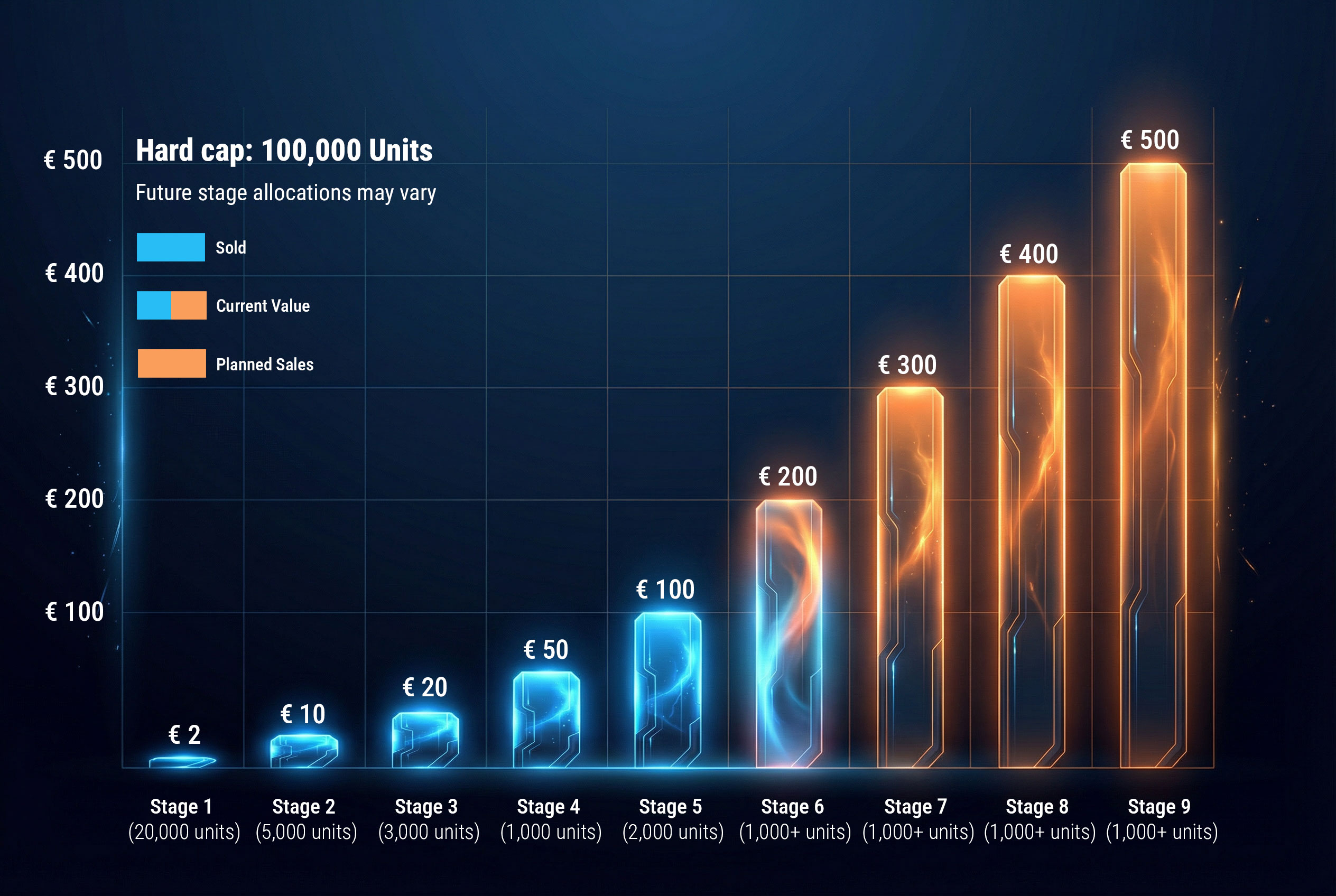
The staged reference value structure is presented as a framework connected to project development stages and documented progress indicators.Each phase may include a limited allocation of Units at a stated website reference value.
This model is intended to explain:
Earlier allocation stages may be presented with different reference values than later stages.
Reference value changes may be connected to documented project milestones, demand and other project-related factors.
Supply is presented as limited within each allocation stage.
The reference value framework is connected to documented project progress, but future value development is not guaranteed.
This structure should be understood through the project documentation and the applicable agreement.
It should not be interpreted as a promise of future value, revenue, liquidity or resale possibility.
Price increases are not arbitrary.
The website presents the following factors as potentially relevant to the reference value framework:
Each stage should be supported, where available, by documented progress indicators in relevant project areas.
The reference value framework may be updated as the project develops, subject to documentation, market conditions and the applicable agreement.
The project is currently positioned at:
Current website reference value: €200 per Unit
This stage reflects completed foundational development and transition into advanced technical refinement.
The current allocation is presented as limited. Availability should be confirmed on the website before acquiring Units.
Participation in the current stage provides entry before the next structural price adjustment.
Access is available while the allocation remains open.
© Nemesys s.r.o. All rights reserved.
Website by globalADVservice.